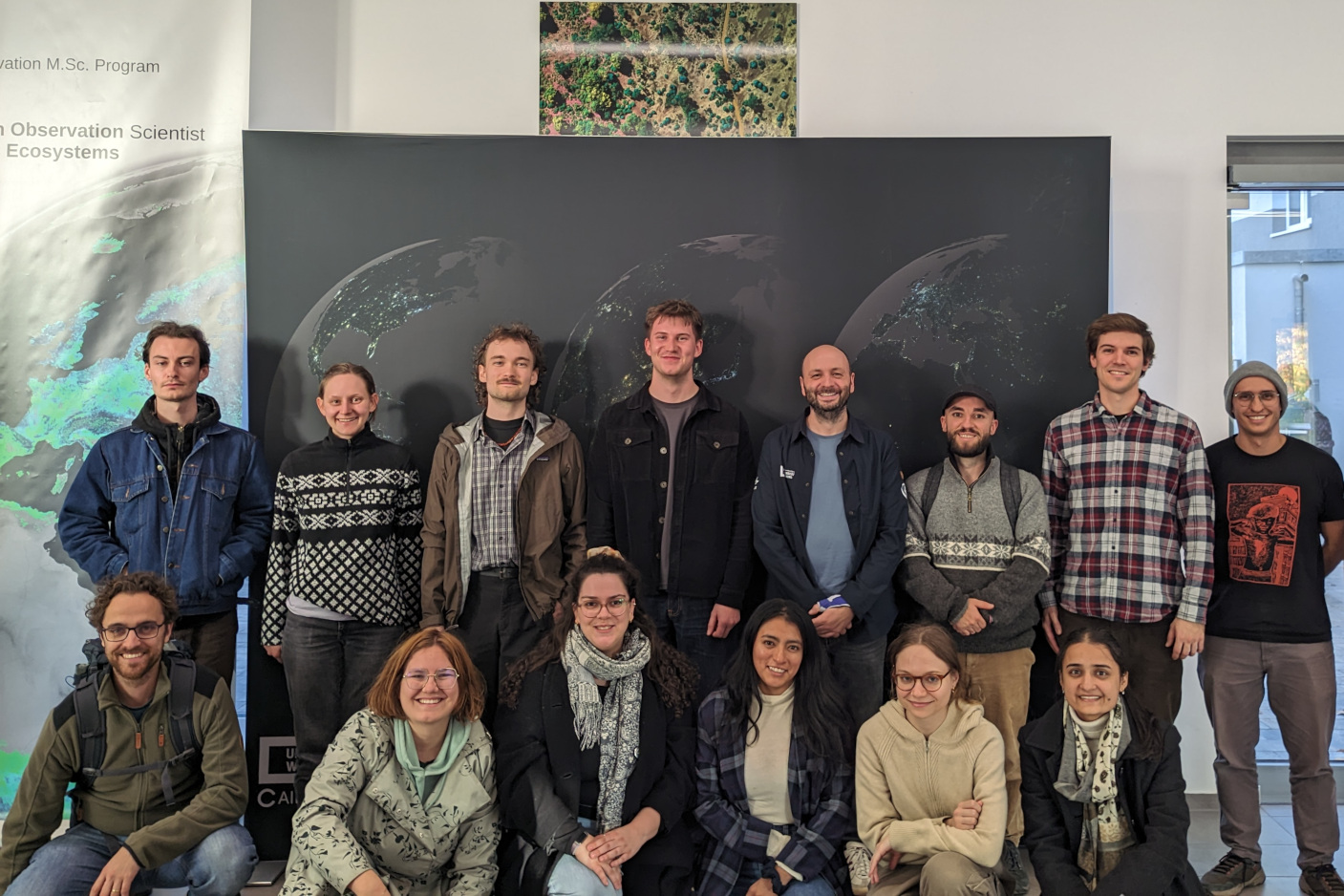
In their third week since the start of the new Master Ecological Forecasting (MEF), the first generation of MEF students has visited University of Würzburg to get to know the Würzburg departments and lecturers involved in the new programme. Accompanied by Dr. Bert van der Veen and Vincent Wilkens, both MEF lecturers from University of Bayreuth, the one-day visit on Wednesday started around 10 a.m. with a welcome at the University of Würzburg’s Center for Artificial Intelligence and Data Science (CAIDAS).
There, MEF lecturers Prof. Dr. Andreas Hotho, head of the data science chair at CAIDAS, and Daniel Weggenmann welcomed the group to introduce CAIDAS and its role in MEF, and, later in the day, give an overview on how Artificial Intelligence is (re-)shaping science and academia. CAIDAS conducts research in machine mearning, data science, image analysis and AI systems at the interface to several research disciplines, including climate and ecosystem research. Andreas Hotho and Daniel Weggenmann are contributing to MEF with modules on Scientific Programming and Deep Learning.
Afterwards, students headed to the University’s Bio centre where MEF lecturers Prof. Dr. Ingolf Steffan-Dewenter, head of the department of animal ecology and tropical biology, Dr. Kim Holzman and Dr. Christina Ganuza gave the group a tour through the facilities. Research and teaching at this department covers major areas of animal ecology, with a focus on biodiversity research, ecosystem functioning, global change, tropical ecology and evolutionary ecology. In MEF, the Bio centre contributes with the module “A Primer in Ecology“, introducing students to ecological concepts and terminology, including fitness, the niche, life history theory, demographics, competition, stoichiometry, disturbance, succession, and diversity partitioning.
At noon, students and lecturers enjoyed a joint lunch at the Mensa Campus Hubland Süd. Later in the afternoon, the group visited University of Würburg’s Earth Observation Research Cluster (EORC), the last stop of the day. There, MEF lectureres Prof. Dr. Tobias Ullmann, acting head of the department of remote sensing and co-lead of the MEF programme, and Dr. Jakob Schwalb-Willmann greeted the students together with EORC researcher Antonio José Castañeda-Gómez. After the group had toured through the EORC, its drone and computer labs and student spaces, students learned how drone and satellite remote sensing research at the EORC not only provides crucial data for quantitative ecology analyses, but also drives interdisciplinary projects at the interface to ecology, geo-spatial modelling, and artificial intelligence – a mix of high relevance for Ecological Forecasting.
The day offered a great opportunity to connect with each other, and to make the students aware of the great potential that lies in the collaboration of different disciplines, both in research and teaching.
The Master Ecological Forecasting prorgamme is a joint initiative between University of Bayreuth and University of Würzburg, funded by the Elite Network of Bavaria (ENB). MEF integrates knowledge and skills from ecology, computational science, statistics, remote sensing, adaptive management, and the science of decision-making. Its goal is to equip graduates with the skills needed to produce quantitative insights into ecological systems, allowing the next generation of researchers and decision makers to generate knowledge that improves our understanding of ecosystem functioning and supports the adaptive management of ecosystems and their biodiversity.
Photo credit: Jakob Schwalb-Willmann (University of Würzburg)